AI UX Audit Lite
Turn interface findings into a reviewable decision workflow.
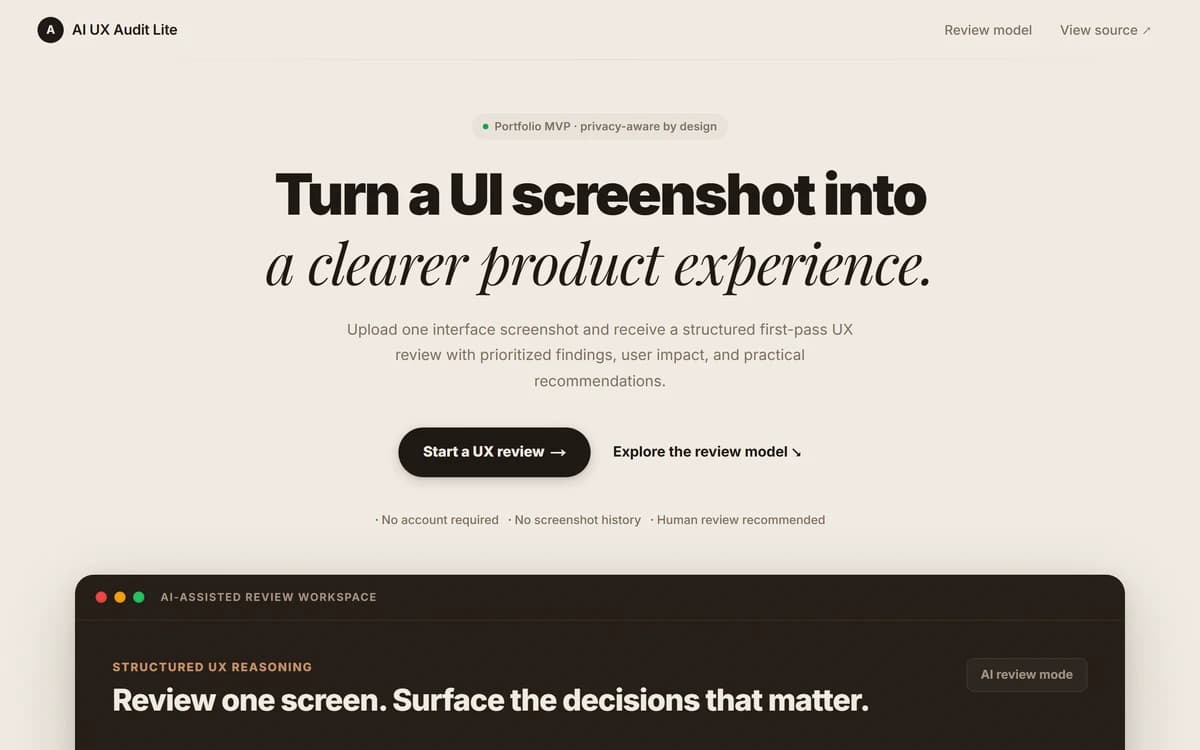
AI UX Audit Lite helps structure heuristic and accessibility findings while keeping the human reviewer in control of severity, rationale, and final review state.
02 · The Problem
UX reviews can become inconsistent, subjective, and difficult to structure across multiple findings. Standard AI audits produce generic unverified checklists that lack human accountability.
03 · Why I Built It
UX reviews can become inconsistent, subjective, and difficult to structure across multiple findings. I wanted a lightweight way to organise observations without handing final judgment to AI.
04 · How It Works
Interface Ingestion
Input viewport screen captures or code references to seed heuristic and accessibility review criteria.
Assisted Finding Generation
AI surfaces potential friction points categorized by WCAG guidelines and Nielsen Norman heuristics.
Human Triage & Override
Reviewer validates severity, edits rationale, assigns review states, or dismisses false positives.
Decision Export
Outputs actionable audit logs formatted for engineering tickets and design backlog prioritization.
05 · Key Product Decisions
AI should propose findings, but a human must explicitly approve severity and remediation.
Requires manual reviewer engagement rather than offering one-click automated sign-off.
Differentiating between unreviewed, accepted, modified, and rejected observations prevents automated bias.
More UI state complexity in the triage interface.
Grounding evaluations in objective standards (WCAG, established heuristics) produces verifiable results.
Constrains reviews to measurable usability criteria rather than subjective aesthetic opinions.
06 · The Product Experience
Direct evidence from the working interface
Visual artifacts are presented truthfully without synthetic mockups or fabricated marketing metrics.
07 · What I Built / My Role
Defined core problem statement, human-in-the-loop architecture, and review workflow.
Created triage interaction patterns, density controls, and status signaling.
Built the responsive Next.js/React interface, state management, and LLM prompt contracts.
08 · Implementation Technologies
Only technologies and architectural patterns actually deployed:
09 · Current Maturity & State
Live prototype in active iteration with testing on real interface design reviews.
10 · Recruiter Evidence
Human-in-the-loop AI UX, accessibility thinking, review-state design, product workflow design, and frontend implementation.
11 · Reflection & Next Steps
AI is most effective in design tools when it acts as an assistant that surfaces patterns for review, not an autonomous decider.
Explore AI UX Audit Lite
Interested in the implementation details, product architecture, or live demo?